I. Product - Related Information
(I) Specifications and Parameters
This product is a low - voltage pure
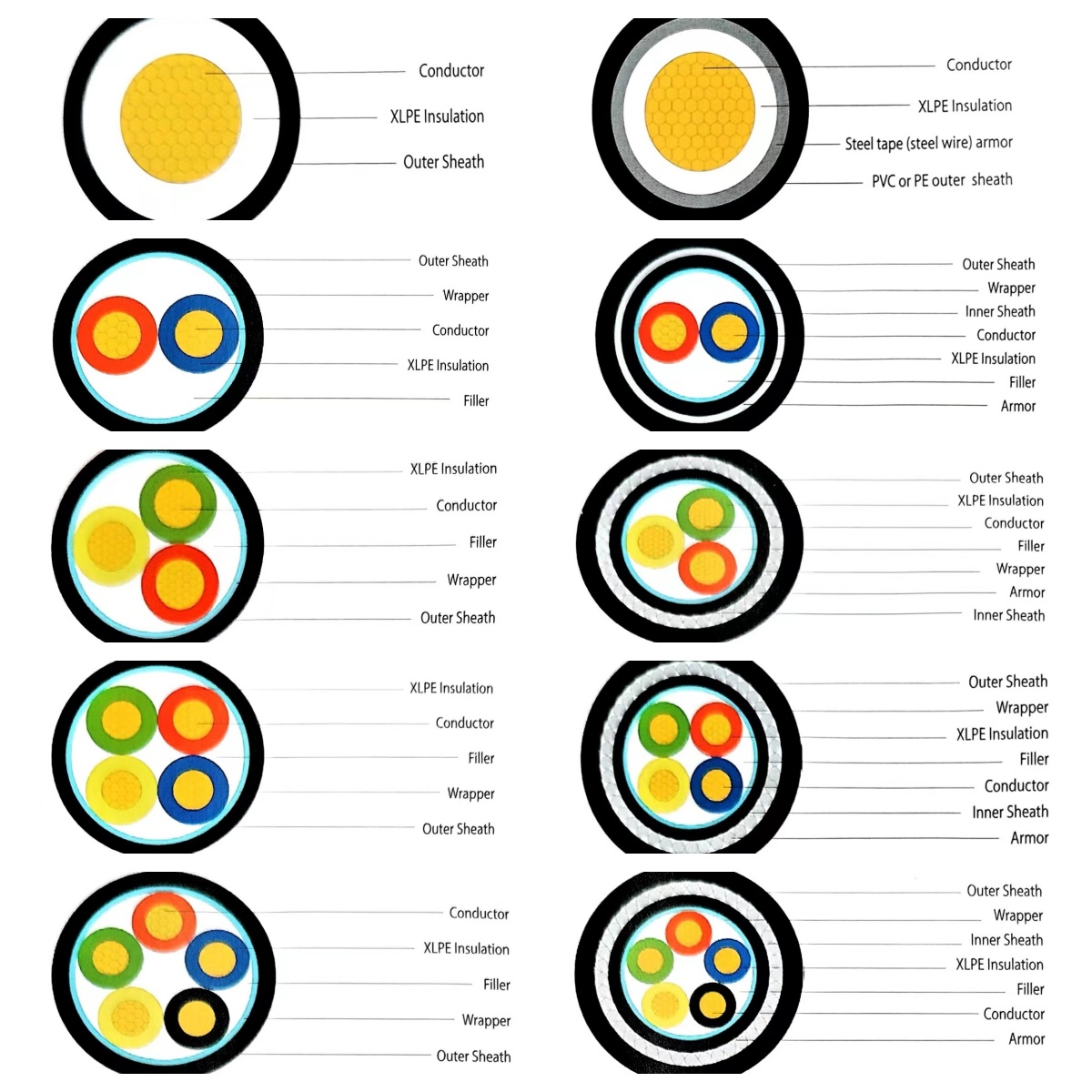
Copper Conductor Cable, with a wide range of models covering specifications from 4X95mm² to 4X300mm², and a rated voltage of 0.6/1kV, which makes it perfectly suitable for low - voltage power transmission scenarios.
In terms of conductor specifications, the 4 - core structural design is very reasonable. The 4 - core structure can meet common power consumption needs such as the three - phase four - wire system. During power transmission, it can correspond to phase wires, neutral wires, etc. respectively, ensuring the stable distribution of electricity. Different cross - sectional area specifications have their own advantages. The 4X95mm² specification is suitable for medium - power power transmission scenarios, while the 4X300mm² specification can meet the needs of high - power power transmission. Cables with different cross - sectional areas can be selected according to actual power requirements, providing flexible solutions for different power consumption scenarios.
(II) Characteristic Uses
Due to its excellent performance, this cable has a wide range of application scenarios. In terms of building power distribution, whether it is residential buildings, commercial buildings or office buildings, a stable and reliable power supply is required. This cable can safely and efficiently transmit electricity from the distribution room to various floors and power terminals, ensuring the normal operation of various electrical equipment such as lighting, air conditioners and elevators.
In the field of industrial equipment power supply, there are a large number of large - scale mechanical equipment in industrial production, such as machine tools and production line equipment. These equipment have high requirements for the stability and safety of electricity. This cable can provide continuous and stable power support for these equipment, reducing production interruptions caused by power supply problems.
In addition, it is also suitable for power laying in some public facilities. Places such as schools, hospitals and gymnasiums are crowded with people and have diverse power needs. This cable can meet their complex power needs and ensure the safety of power supply. At the same time, this cable can also play an important role in scenarios such as internal power connection of small factories and outdoor temporary power supply.
(III) Material and Style
Conductor Material
The core part of the cable uses pure copper (Copper) conductors. Pure copper, as a conductor material, has many significant advantages. Firstly, pure copper has excellent electrical conductivity, which means that current can flow smoothly during power transmission, greatly reducing resistance loss and thus improving the efficiency of power transmission. Secondly, pure copper has good thermal conductivity. When the cable generates a certain amount of heat during operation, it can dissipate quickly, avoiding the impact on the performance and service life of the cable due to heat accumulation.
Moreover, pure
Copper Conductors have good mechanical strength and can withstand a certain amount of tension and pressure, so they are not easy to break or be damaged during the laying and use of the cable. At the same time, pure copper has good corrosion resistance and can resist the erosion of some corrosive substances in the external environment, further extending the service life of the cable.
Insulation Layer Material
The insulation layer is made of cross - linked polyethylene (XLPE) material, which is an excellent insulating material. It has excellent high and low temperature resistance and can work stably for a long time in an environment of - 40℃ to 90℃. Its insulation performance will not be affected in cold winters, hot summers, or some industrial environments with temperature fluctuations.
XLPE material also has the characteristic of chemical corrosion resistance, which can resist the erosion of a variety of chemical substances, ensuring that the insulation layer will not be damaged in some environments with chemical pollution, thus ensuring the safety of power transmission. In addition, its insulation performance is stable, with a small dielectric constant and large insulation resistance, which can effectively prevent current leakage, reduce power loss, and ensure the efficiency and safety of power transmission. At the same time, XLPE material has strong anti - aging properties and will not easily crack or harden after long - term use, extending the insulation life of the cable.
Sheath Layer Material
The sheath layer is made of polyvinyl chloride (PVC) material. PVC material has good wear resistance. During the laying, handling and use of the cable, it can resist external friction and collision, reducing damage to the sheath layer. It also has excellent weather resistance and can withstand the impact of natural environments such as sunlight and wind and rain erosion, maintaining good performance when used outdoors.
Furthermore, PVC material has flame - retardant performance. When exposed to an open flame, it can inhibit the spread of the flame, reduce the risk of fire accidents, and provide additional safety guarantees for power transmission. The sheath layer can provide reliable protection for the internal structure of the cable, resisting external mechanical damage, moisture and chemical erosion, and ensuring that the cable can work normally in various complex environments.
Style Design
The cable adopts a multi - core structure (
4 Cores), which meets common power transmission needs. The 4 - core structure can meet the power requirements of the three - phase four - wire system. In the power system, three - phase electricity can provide stable power, and the neutral wire is used to balance the three - phase current to ensure the normal operation of electrical equipment.
The overall appearance design is simple and elegant. The sheath layer has a uniform color and a smooth surface, which is easy to identify and lay. Cables of different specifications are distinguished by the difference in cross - sectional area in appearance, making it convenient for users to choose according to actual needs.
(IV) Production Process
Conductor Manufacturing
The manufacturing of pure
Copper Conductors goes through a strict process. Firstly, high - quality pure copper raw materials are selected to ensure that the purity and performance of the raw materials meet the requirements. Then, the copper material is drawn into
Copper Wires of the required diameter through a wire drawing process. During the wire drawing process, the drawing speed and tension need to be precisely controlled to ensure the dimensional accuracy and mechanical properties of the copper wires.
After that, multiple copper wires are stranded to form a conductor. The stranding process can improve the
Flexibility and bending performance of the conductor, making it easy to lay the cable. During the stranding process, it is necessary to ensure that the copper wires are arranged evenly and tightly to avoid looseness and broken wires. After stranding, the conductor is annealed. Through heating and cooling processes, the internal stress of the conductor is eliminated, and the electrical and mechanical properties of the conductor are improved.
Insulation Layer Extrusion
When extruding the XLPE insulation layer on the outer layer of the conductor, advanced extrusion equipment and processes are adopted. Firstly, the XLPE material is pretreated to remove impurities and moisture, ensuring the purity of the material. Then, the treated material is added to the extruder and melted and plasticized under high temperature and pressure.
The melted XLPE material is evenly coated on the surface of the conductor through a mold to form an insulation layer. During the extrusion process, the extrusion temperature, speed and pressure need to be precisely controlled to ensure that the insulation layer has a uniform thickness, a smooth surface and is closely combined with the conductor. After extrusion, the insulation layer is cross - linked. Through heating and other methods, the XLPE molecules form a cross - linked structure, thereby improving the performance of the insulation layer.
Sheath Layer Extrusion
The extrusion process of the sheath layer is similar to that of the insulation layer, but the process parameters need to be adjusted according to the characteristics of the PVC material. Firstly, the PVC material is mixed evenly with relevant additives (such as plasticizers, stabilizers, flame retardants, etc.) in a certain proportion to ensure that the material has good processing performance and performance indicators.
Then, the mixed material is added to the extruder, melted and plasticized, and then coated on the outer layer of the insulation layer through a mold to form a sheath layer. During the extrusion process, parameters such as extrusion temperature and speed should be controlled to ensure that the sheath layer has a uniform thickness, a flat surface and is closely combined with the insulation layer. After extrusion, the sheath layer is cooled to make it shape quickly.
Finished Product Inspection
The cables after production need to undergo strict finished product inspection. The inspection items include appearance inspection, dimension measurement, electrical performance testing, mechanical performance testing, etc. The appearance inspection mainly checks whether the sheath layer of the cable has defects such as damage, bubbles and depressions; the dimension measurement checks whether the conductor cross - sectional area, insulation layer thickness and sheath layer thickness meet the specification requirements; the electrical performance testing includes insulation resistance testing and voltage resistance testing to ensure that the insulation and conductive performance of the cable meet the standards; the mechanical performance testing includes tensile strength and elongation at break to inspect whether the mechanical strength of the cable meets the standards. Only cables that pass all inspection items can be judged as qualified products.
II. General Product Information
(I) Packaging
Packaging Materials
In order to ensure that the cable is not damaged during transportation and storage, appropriate packaging materials are used. For small - size cables, cardboard boxes are usually used for packaging. Cardboard boxes have a certain degree of strength and rigidity and can resist a certain amount of external impact. Moisture - proof paper is placed inside the box to prevent the cable from getting damp.
For large - size and long - length cables, cable reels are used for packaging. There are two types of cable reels: wooden and steel. Wooden cable reels are lighter in weight and lower in cost, suitable for short - distance transportation; steel cable reels have higher strength and stronger bearing capacity, suitable for long - distance transportation and multiple uses. The size of the cable reel is designed according to the specification and length of the cable to ensure that the cable can be neatly wound on the cable reel.
Packaging Methods
In the packaging process, the cable is first neatly wound on the cable reel or put into a cardboard box to avoid twisting and knotting of the cable. For cables packaged with cable reels, protective devices are installed at both ends of the cable to prevent damage to the cable ends. Then, the entire cable is wrapped with stretch film to play a role in moisture proofing and dust proofing.
In the cardboard box packaging, buffer materials such as foam and bubble film are filled inside the box to reduce the shaking and collision of the cable during transportation. After packaging, the product information such as product name, specification, length, quantity, production date and batch number is marked on the outside of the package to facilitate user identification and acceptance. At the same time, warning signs such as "Do Not Invert" and "Handle with Care" are also marked to remind transportation and handling personnel to pay attention.
(II) Transportation
Transportation Methods
According to factors such as the customer's geographical location, order quantity and delivery time, appropriate transportation methods are selected. For domestic short - distance transportation, road transportation is usually adopted. Road transportation has the advantages of high flexibility and good directness, and can quickly deliver products to customers. The transport vehicles are selected as trucks suitable for transporting cables to ensure that the carrying capacity and stability of the vehicles meet the requirements.
For domestic long - distance transportation or large - batch transportation, railway transportation can be chosen. Railway transportation has the characteristics of large transportation volume, low cost and good stability, which is suitable for long - distance and large - scale cargo transportation. For export orders, sea or air transportation is adopted. Sea transportation is suitable for large - batch orders that do not have high requirements on delivery time and has a low cost; air transportation is suitable for small - batch and urgent orders and can quickly deliver products to the destination.
Transportation Precautions
During transportation, the following matters need to be noted. Firstly, the cables should be placed neatly during loading to avoid mutual extrusion and collision. For cables packaged with cable reels, they should be fixed firmly to prevent rolling and tilting during transportation. During loading, they should be handled with care to avoid damaging the package and the cable.
During transportation, the cable should be protected from direct sunlight, rain and damp environments. For vehicles transported in the open air, a tarpaulin should be covered for protection. At the same time, the cable should be prevented from contacting with corrosive substances and sharp objects to avoid damage to the cable. Transport vehicles should abide by traffic rules and drive smoothly, avoiding sudden braking and sharp turns to reduce the shaking and impact of the cable. During transportation, the cable should be inspected regularly, and problems should be handled in a timely manner.
(III) Shipment
Shipment Process
After the customer places an order, the staff will review the order in a timely manner to confirm whether the order information (such as product specifications, quantity, delivery address, etc.) is accurate. After passing the review, the warehouse is notified to prepare the goods. Warehouse managers find the corresponding products according to the order information, count and check them to ensure that the specifications and quantity of the products are consistent with the order.
After the goods are prepared, the products are packaged in strict accordance with the packaging standards. After packaging, the products are transported to the shipping area to wait for the arrival of the transport vehicle. At the same time, the staff will contact the transport company to arrange the transport vehicle and transport time. When the transport vehicle arrives, the products are loaded onto the vehicle, and relevant transport procedures (such as waybills, delivery orders, etc.) are handled. After the shipment is completed, the shipping information (such as the transport company and waybill number) is promptly notified to the customer to facilitate the customer to track the logistics information of the goods.
Shipment Time
When the inventory is sufficient, for products of conventional specifications, shipment is usually completed within 1 - 3 working days after the customer places the order. For products of special specifications or large - batch orders, the shipment time needs to be determined according to the production progress. Generally speaking, the production cycle varies according to the specifications and quantity of the products. The staff will inform the customer of the expected shipment time in a timely manner after the order is confirmed and keep in touch with the customer to communicate the production progress during the production process.
In case of special circumstances such as holidays and bad weather, the shipment time may be delayed. The staff will notify the customer in advance, explain the reason, and negotiate a solution with the customer.
(IV) Samples
Sample Provision
To facilitate customers to understand the performance and quality of the products, the company provides sample services. Customers can put forward sample requirements to the sales staff and specify the specifications and quantity of the required samples. For samples of conventional specifications, the company usually provides them free of charge, but the customer needs to bear the transportation cost of the samples. For samples of special specifications, a certain sample production fee may be charged. The specific fee is determined according to the specifications and production difficulty of the samples and is produced after the customer confirms.
Sample Delivery
After the samples are produced or retrieved from the inventory, the staff will package the samples to ensure that they are not damaged during transportation. Relevant information about the samples (such as product specifications and company name) is marked on the package. Then, a suitable express delivery method is selected to send the samples to the customer, and the express delivery number is notified to the customer to facilitate the customer to check the logistics information of the samples. The sample delivery time varies according to the distance from the customer's location, and it is usually delivered within 1 - 7 working days.
(V) After - sales Service
Quality Assurance
The company provides quality assurance for all products. The warranty period of the products is 12 months from the date of acceptance of the products. During the warranty period, if the product has quality problems caused by non - human factors (such as conductor breakage, insulation layer damage, substandard electrical performance, etc.), the company will provide free repair, product replacement and other services according to the specific situation.
After - sales Service Process
If a customer finds a quality problem during the use of the product, they can contact the company's after - sales service staff in a timely manner, explain the problem and provide relevant evidence (such as photos and videos). After receiving the feedback, the after - sales service staff will verify and investigate in a timely manner to determine the cause and responsibility of the problem.
If it is a product quality problem, the after - sales service staff will negotiate a solution with the customer (such as repair, replacement, etc.) and complete the relevant services within the specified time. If the damage is caused by human factors, the company can also provide repair services for the customer, but the corresponding repair fees and parts fees need to be charged.
Technical Support
The company's after - sales service team not only provides solutions to quality problems but also provides technical support for customers. Customers can consult the after - sales service staff if they encounter any technical problems during the selection, laying, installation and use of the cable. The after - sales service staff will provide professional answers and suggestions according to the customer's problems to help customers solve practical problems. At the same time, the company will also conduct regular return visits to customers to understand the use of the products, collect customers' opinions and suggestions, and continuously improve product and service quality.


 English
 Español
 Pусский
 Français
 العربية
 ไทย
ไทย Türk dili
 Indonesia
 Tiếng Việt



 Telefone
 Correspondência