Detailed Introduction to NYY, NYY-0/J Cables (240mm² Single and 1/2/3/4/5 Core Copper Power Cables with PVC, XLPE Insulation)
I. From the Perspective of the Product Itself
(1) Specification Parameters
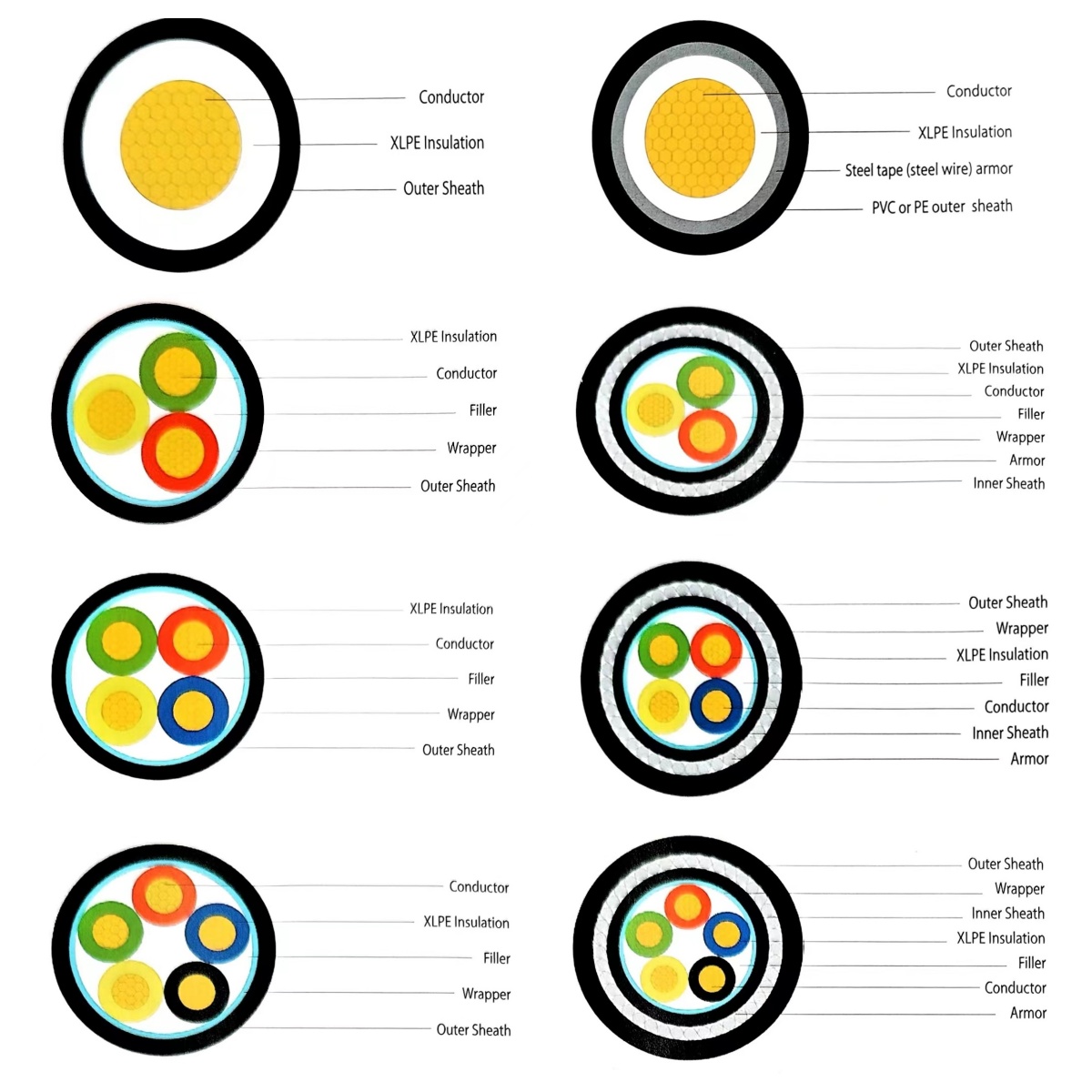
The NYY and NYY-0/J series
Power Cables have detailed and comprehensive specification parameters, which can accurately meet the medium and high-voltage power transmission needs in different scenarios.
This series of cables has a cross-sectional specification of 240mm², with core numbers covering 1, 2, 3, 4, and
5 Cores. For the 1-
Core Cable, the conductor diameter is approximately [X]mm, the overall outer diameter is about [X]mm, and the weight per meter is about [X]kg. In terms of current-carrying capacity, it is approximately 520A when laid in the air and about 630A when laid underground.
Each conductor diameter of the 2-core cable is also approximately [X]mm, the overall outer diameter is about [X]mm, and the weight per meter is about [X]kg. The current-carrying capacity when laid in the air is about 490A, and when laid underground, it is about 590A.
The conductor diameter of the 3-core cable is consistent with the above, the overall outer diameter is about [X]mm, and the weight per meter is about [X]kg. The current-carrying capacity when laid in the air can reach 480A, and when laid underground, it reaches 580A. This current-carrying capacity can efficiently support the high-power power transmission of the three-phase AC power supply system.
In the 4-core cable, the diameter of the main core is about [X]mm, the diameter of the neutral core is about [X]mm according to the design, the overall outer diameter is about [X]mm, and the weight per meter is about [X]kg. The current-carrying capacity when laid in the air is about 470A, and when laid underground, it is about 570A.
The diameter of the main core of the 5-core cable is about [X]mm, the diameter of the neutral and ground cores is about [X]mm, the overall outer diameter is about [X]mm, and the weight per meter is about [X]kg. The current-carrying capacity when laid in the air is about 460A, and when laid underground, it is about 560A.
In terms of electrical performance, the insulation resistance of this series of cables is not less than 100MΩ·km at room temperature, and can withstand a power frequency withstand voltage test of 1kV and above without breakdown. For cables with XLPE insulation, their dielectric loss does not exceed [X]% under rated voltage, and the insulation strength is higher, which can adapt to higher working voltage levels, up to [X]kV.
In terms of mechanical performance, the tensile strength of the cable is ≥12MPa, and the elongation at break is ≥150%, which can withstand operations such as bending and dragging during laying. In terms of bending radius, the
Single-Core Cable is not less than 12 times the cable outer diameter, and the
Multi-Core cable is not less than 10 times the cable outer diameter, ensuring that it will not be damaged due to excessive bending during installation.
(2) Characteristic Uses
The NYY and NYY-0/J series 240mm² cables have distinctive applications in many fields due to their diverse core number designs, high-performance
Insulation Materials, and strong current-carrying capacity.
In the industrial field, 3-core and 4-core cables are the "power source" of large production equipment. Large motors, compressors and other equipment require a stable three-phase AC power supply. The 3-core cable can efficiently transmit power to ensure the continuous operation of the equipment. In some production lines that need to transmit power and perform safe grounding at the same time, 4-core cables play an important role. The neutral wire and
Ground Wire can effectively protect the equipment and operators, such as welding production lines in automobile manufacturing plants and steel rolling equipment in steel plants.
In the energy industry,
1-Core and 3-core cables are indispensable in new energy power generation systems. The connection between wind turbines and collector lines in wind farms often uses 1-core high-
Voltage Cables, which can adapt to harsh outdoor environments and efficiently transmit power generated by wind energy. The grid-connected transmission lines of photovoltaic power plants mostly use 3-core cables to centrally transmit the electric energy generated by multiple photovoltaic arrays to the step-up station and then connect to the power grid. In traditional thermal power plants and hydro
Power Stations, this series of cables is also used to connect generator sets and power distribution systems, undertaking the task of high-power power transmission.
In the construction field, 5-core cables are the "lifeline" of high-rise buildings and large commercial complexes. These places have a large number of high-power electrical equipment, such as central air conditioners, elevators, large water pumps, etc. As the main line, 5-core cables can transmit three-phase power, neutral wire and ground wire at the same time, meeting the power demand of the equipment and ensuring electrical safety. For example, the power transmission from the underground distribution room of a skyscraper to the distribution rooms on each floor, and the power supply of the central computer room of a large shopping mall, etc., are inseparable from the support of 5-core cables.
In municipal engineering, this series of cables plays an important role in urban power grid transformation. 3-core and 4-core cables are often used in the laying of
Underground Cable lines. Compared with
Overhead Lines,
Underground Cables are less affected by weather and have higher power supply reliability. The street lamp power supply system on urban main roads and the power supply of underground parking lots can all use this series of cables. In addition, in urban rail transit systems such as subways and light rails, 3-core cables are used for power transmission from traction substations to rail vehicles to ensure the normal operation of trains.
In data centers and communication hubs, 2-core and 3-core cables also have their unique uses. The connection between the backup generator of the data center and the main power distribution system often uses 2-core cables, which can quickly switch to generator power supply when the mains power is interrupted, ensuring the uninterrupted operation of the data center. The equipment in the communication hub's computer room requires a stable three-phase power supply, and 3-core cables can provide reliable power support to ensure the smooth flow of the communication network.
(3) Material and Style
The NYY and NYY-0/J series cables pursue a combination of high performance and practicality in material selection, and their style design is also fully adapted to different application scenarios.
The conductor is made of high-purity electrolytic copper with a purity of ≥99.9%. This material has excellent electrical conductivity, with a conductivity of more than 100% IACS (International Annealed Copper Standard), which can effectively reduce energy loss during power transmission. High-purity copper also has good ductility and toughness, which is not easy to break during production and laying, ensuring the service life of the cable.
There are two choices of insulation materials: polyvinyl chloride (PVC) and cross-linked polyethylene (XLPE).
PVC Insulation Material has excellent mechanical strength, can withstand a certain amount of external impact, and has good chemical corrosion resistance, which can resist the erosion of acids, alkalis, oils and other substances in the industrial environment. Its applicable temperature range is -15℃ to 60℃, which is suitable for indoor and general outdoor environments.
XLPE Insulation Material transforms the linear molecular structure into a three-dimensional network structure through cross-linking technology, which greatly improves the temperature resistance performance. It can work stably in a wide temperature range of -40℃ to 90℃, has strong anti-aging ability, low dielectric loss and high insulation strength, and is suitable for harsh environments such as high voltage, high temperature and outdoors.
The shielding layer (for some models) is made of copper tape wrapping or
Copper Wire braiding. The copper tape wrapped shielding layer has a good shielding effect, can effectively block electromagnetic interference, and is suitable for occasions with high requirements for shielding performance; the copper wire braided shielding layer has better
Flexibility, is convenient for bending and laying, and has more advantages in some scenes that need frequent movement or bending. The existence of the shielding layer ensures that the cable will not cause electromagnetic interference to surrounding electronic equipment when transmitting power, and can also prevent external electromagnetic signals from interfering with the normal operation of the cable.
The outer sheath is made of polyvinyl chloride (PVC) material, mostly black or gray. The
PVC Sheath has high wear resistance and impact resistance, which can protect the internal structure of the cable from mechanical damage. At the same time, it also has certain weather resistance, can resist the impact of natural environments such as direct sunlight and wind and rain erosion, and prolong the service life of the cable. According to different laying methods, the outer sheath can also be specially treated, such as adding flame retardants to make flame-retardant sheaths, which are suitable for places with fire protection requirements.
In terms of style, in addition to the difference between single-core and multi-core, cables are also divided into armored and non-armored.
Armored Cables add a layer of metal armor outside the sheath, such as
Steel Tape armor or steel wire armor, which can significantly improve the cable's resistance to mechanical damage and pressure, and are suitable for scenarios prone to external impact such as underground laying and bridge laying. Non-armored cables are lighter in weight and more flexible, suitable for indoor laying, pipeline laying and other environments.
(4) Production Process
The production process of NYY and NYY-0/J series cables is a sophisticated system engineering, and every process is strictly controlled to ensure product quality.
The production of conductors starts with the smelting of high-purity electrolytic copper. After removing impurities, copper rods are made by continuous casting. The copper rod is drawn into a copper wire with uniform diameter by a wire drawing machine. During the wire drawing process, the wire drawing speed and the precision of the die must be accurately controlled to ensure that the size of the copper wire meets the requirements. Subsequently, multiple copper wires are stranded to form a conductor. The stranding process can improve the flexibility and filling factor of the conductor. The stranding pitch is strictly controlled according to the cable specifications to ensure the roundness and mechanical properties of the conductor.
The extrusion of the insulation layer is one of the key processes. For the
PVC Insulation layer, PVC granules are added to the extruder, heated and melted, and then uniformly coated on the surface of the conductor through a die. During the extrusion process, the extrusion temperature (usually 160-190℃), speed and pressure must be accurately controlled to ensure that the thickness of the insulation layer is uniform, the surface is smooth, and there are no defects such as bubbles and depressions. The thickness of the insulation layer must be strictly in accordance with the standards to ensure its insulation performance.
The production of XLPE insulation layer is more complex, using cross-linking technology. First, the XLPE material is melt-extruded in the extruder and coated on the conductor to form an insulation layer, then the polyethylene molecules are cross-linked through warm water cross-linking, steam cross-linking or radiation cross-linking to form a three-dimensional network structure. The temperature, time and other parameters of the cross-linking process need to be accurately controlled to ensure that the cross-linking degree meets the requirements (usually more than 70%), so as to endow the insulation layer with excellent temperature resistance and mechanical properties.
The production of the shielding layer varies according to the type. Copper tape wrapped shielding is to wrap the copper tape around the insulation layer with a certain overlap rate, and the wrapping tension should be uniform to ensure the tightness of the shielding layer. Copper wire braided shielding is to braid copper wires on the insulation layer at a certain angle and density through a braiding machine. The braiding density is usually not less than 80% to ensure a good shielding effect.
In the cabling process of
Multi-Core Cables, multiple
Insulated Wire cores are stranded together according to a certain stranding method (such as circular stranding, sector stranding). During the stranding process, filling materials must be added to make the cable structure round. After cabling, a layer of tape is wrapped outside to prevent the wire core from loosening.
The extrusion of the outer sheath is similar to that of the insulation layer, but the formula of the PVC material used is different to enhance its mechanical properties and weather resistance. The cabled wire core is put into the sheath extruder to extrude the outer sheath, ensuring that the sheath is closely combined with the internal structure without gaps to prevent moisture and impurities from entering.
During the production process, each process is equipped with strict quality inspection. The diameter, resistance, tensile strength and other parameters of the conductor are sampled and tested; the thickness, appearance, voltage resistance performance of the insulation layer and sheath are comprehensively inspected; the resistance and shielding effectiveness of the shielding layer also need to be tested. The finished cable also needs to undergo overall mechanical performance tests, aging resistance tests, flame retardant tests, etc., to ensure that each batch of cables meets relevant standards.
II. From the Perspective of General Product Information
(1) Packaging
The packaging design of NYY and NYY-0/J series 240mm² cables fully considers the protection, transportation and storage needs of the products to ensure that the cables are not damaged during circulation.
For single-core and small-sized multi-core cables (such as 1-core, 2-core), wooden cable reels are usually used for packaging. The diameter of the cable reel depends on the length of the cable, generally 1.2 meters, 1.5 meters or 2 meters. The cable is neatly wound on the cable reel, and appropriate tension is maintained during the winding process to avoid loosening or twisting of the cable. Both sides of the cable reel are equipped with thick wooden baffles, the height of which is higher than the winding height of the cable to prevent the cable from sliding off the side. After winding, the surface of the cable will be wrapped with a layer of plastic film to play a role in moisture-proof and dust-proof. Labels will also be fixed on the cable reel, indicating the product name, specification, model, length, weight, production batch number, implementation standard and other information.
3-core, 4-core, 5-core and other large-sized multi-core cables are packaged with iron-wood composite cable reels. This kind of cable reel is mainly made of wooden discs, with metal materials reinforced at the edges and central axis, which improves the strength and bearing capacity of the cable reel and can bear the weight of heavier cables. The winding method of the cable is the same as that of the wooden cable reel, and the outer layer is also wrapped with plastic film. For exported products or cables transported over long distances, iron sheet packaging will be added outside the cable reel to further enhance the protection ability and prevent damage due to collision during transportation.
In terms of storage, packaged cables should be stored in a dry, ventilated and cool warehouse to avoid direct sunlight, rain and snow. The cable reel should be placed horizontally on a flat ground, and wooden pillows can be placed under it to prevent the ground from getting damp and affecting the cable. Cables of different specifications and models should be stored separately with obvious signs for easy management and access. During storage, the packaging of the cable should be checked regularly for intactness, moisture, damage, etc., to ensure that the cable remains in good condition before use.
(2) Transportation
The transportation of NYY and NYY-0/J series cables needs to strictly follow relevant regulations to ensure that the products are delivered to the destination safely and timely.
The choice of transportation mode depends on the transportation distance, quantity of goods and customer needs. Short-distance transportation (such as in the city or surrounding areas) mostly uses road transportation, and large trucks or semi-trailers can be used. The compartment should be clean, dry and free of sharp debris. During transportation, the cable reel should be firmly fixed in the compartment, and steel wire ropes or fastening belts can be used to connect the cable reel with the compartment to prevent sliding or tipping due to bumps and turns during driving. For multiple cable reels, a certain gap should be left between the reels to avoid mutual collision.
Long-distance transportation can choose railway transportation or waterway transportation. Railway transportation is suitable for large quantities of cable transportation, with the advantages of large transportation volume, low cost and good stability. The cable reel should be placed on the flat car of the railway freight car, also need to be firmly fixed, and covered with rain cloth to prevent moisture. Waterway transportation is suitable for cross-regional or export transportation. The cable reel is loaded into a container or placed on the deck of a cargo ship. The fixing method is similar to that of railway transportation. At the same time, waterproof and moisture-proof measures should be taken to avoid seawater erosion.
During transportation, the cable should be avoided from severe impact and vibration, and it is strictly forbidden to throw or roll the cable reel. When loading and unloading the cable reel, forklifts or cranes should be used, and the loading and unloading point should be selected on a solid ground to avoid accidents due to ground collapse. The length of the fork teeth of the forklift should be greater than the radius of the cable reel. When lifting, special spreaders should be used to hook the central axis of the cable reel to ensure stable loading and unloading.
During transportation, there should be special personnel responsible for escorting. The escorts should be familiar with the characteristics and transportation requirements of the cables, and regularly check the fixing of the cable reels and the integrity of the packaging. In case of bad weather (such as heavy rain, high temperature, severe cold, etc.), corresponding protective measures should be taken, such as shading the cable in high temperature and preventing the cable from freezing in severe cold. After arriving at the destination, check the appearance and packaging of the cable together with the receiver, and sign for the handover only after confirmation.
(3) Delivery
The delivery process of NYY and NYY-0/J series cables is standardized and orderly, aiming to ensure that the products are sent to customers accurately and timely.
After the customer places an order, the sales department will immediately enter the order information into the system and transmit it to the production department and warehouse. If the production department has spot goods, it will notify the warehouse to prepare goods; if it is a customized product, production will be organized according to the order requirements to ensure completion within the specified delivery period. After receiving the notice to prepare goods, the warehouse will search for the corresponding products according to the order information and check the specifications, models, quantities, lengths, etc., to ensure consistency with the order.
After the goods are prepared, the warehouse management personnel will conduct a comprehensive visual inspection of the cables, checking whether the insulation layer and sheath of the cables are damaged or scratched, and whether the labels are clear and complete. At the same time, they will check the product quality certification documents, such as factory inspection reports and certificates of conformity, to ensure that the product quality is qualified. For orders with special requirements, such as the need to provide third-party testing reports, the warehouse will prepare the relevant documents in advance.
Before shipment, the warehouse will contact the logistics company and select the appropriate transportation mode and vehicle type according to the quantity, weight and transportation distance of the goods. A transportation contract will be signed with the logistics company to clarify the rights and obligations of both parties, including transportation time, freight, cargo insurance, etc. The logistics company will arrange vehicles to pick up the goods from the warehouse. The warehouse management personnel and the driver will jointly check the goods information, go through the handover procedures, and sign for confirmation on the freight bill.
After the goods are shipped, the sales department will promptly inform the customer of the shipment information, including the name of the logistics company, waybill number, estimated arrival time, etc., to facilitate the customer to track the dynamics of the goods. At the same time, the sales department will maintain communication with the logistics company to understand the transportation progress of the goods. In case of transportation delays, road congestion and other situations, it will promptly inform the customer and coordinate to solve the problem. After the goods arrive at the customer's designated location, the sales department will conduct a return visit to confirm whether the customer has received the goods and the integrity of the goods.
(4) Samples
To enable customers to better understand the performance and quality of NYY and NYY-0/J series 240mm² cables, the company provides convenient sample services.
Customers can apply for samples through various channels such as phone calls, emails, and online customer service, indicating the specifications, core numbers, types of insulation materials, and uses of the required samples. Sales representatives will respond to customer applications in a timely manner, understand the specific needs of customers, and recommend appropriate sample models for them.
Samples are prepared in strict accordance with mass production processes and standards to ensure that the performance of the samples is consistent with that of mass-produced products. The length of the sample is generally 1-3 meters, and can be adjusted appropriately according to customer requirements. After the sample is prepared, it will undergo the same quality inspection as the finished product, including appearance inspection, insulation resistance test, voltage withstand test, etc., to ensure that the sample meets relevant standards.
Samples are packaged in small cartons or plastic reels, with information such as product specifications, models, and sample numbers marked on the packaging, and accompanied by product manuals, quality inspection reports and other materials. The delivery method of samples is selected according to the customer's geographical location and needs. Domestic customers usually use express delivery, while international customers can send samples via international express or air freight to ensure that the samples can be delivered to customers quickly and safely.
Regarding sample fees, for customers with clear purchase intentions, the company usually provides samples free of charge, only charging express fees; for ordinary consulting customers, a certain sample cost may be charged, which can be deducted from the payment when the customer makes subsequent bulk purchases. After receiving the samples, if customers have any questions about the samples or need further technical support, the company's technical personnel will provide professional answers and guidance to assist customers in sample testing and evaluation.
(5) After-sales Service
The NYY and NYY-0/J series cables have a complete after-sales service system to provide customers with comprehensive support and protection.
In terms of product quality assurance, the company promises that under normal use conditions, the product has a warranty period of [X] years. During the warranty period, if the cable is damaged or cannot be used normally due to product quality problems, the company will provide free repair, replacement or return services according to the actual situation. For damage caused by improper use, installation or man-made factors, the company will provide paid maintenance services, and the maintenance costs will be charged reasonably according to the extent of the damage.
The technical support team is composed of professional and technical personnel with rich experience in cable installation, debugging and maintenance. They can provide customers with full-process technical guidance, including pre-sales product selection advice, on-site guidance during installation and laying, and troubleshooting during use. Customers can contact the technical support team through hotlines, emails, online platforms, etc. The team will respond within 24 hours and provide effective solutions. For complex technical problems that cannot be solved remotely, the company can arrange technical personnel to visit the site for handling, and the service will be completed within a specified time.
The company attaches great importance to customer feedback and has established a sound customer feedback mechanism. Customers can put forward opinions and suggestions on product quality, service attitude, delivery speed, etc., through various channels. The after-sales service department will sort out and classify the feedback information, and conduct in-depth analysis to find out the root causes of the problems. For customer complaints, a special person will be assigned to follow up, and the processing results will be fed back to the customer in a timely manner until the customer is satisfied.
In addition, the company regularly conducts customer return visits, especially for key customers and large projects. The after-sales personnel will communicate with customers to understand the use of cables, collect customer opinions and suggestions on product performance and service, and report them to the relevant departments of the company. The company will use this as a basis to continuously improve product quality and service levels, and launch more products that meet customer needs.
For large-scale projects, the company can also provide customized after-sales service plans, including regular on-site inspections, preventive maintenance, and technical training for customer maintenance personnel. Regular inspections can detect potential problems in advance and deal with them in a timely manner to avoid equipment failures and production losses caused by cable problems. Technical training can improve the customer's ability to maintain and manage cables, ensuring the safe and stable operation of the cable system.
The company's after-sales service adheres to the principle of "customer first" and is committed to solving customer problems and improving customer satisfaction. Through professional and efficient after-sales service, the company has established long-term and stable cooperative relations with many customers, winning a good reputation in the industry.


 English
 Español
 Pусский
 Français
 العربية
 ไทย
ไทย Türk dili
 Indonesia
 Tiếng Việt



 Telefone
 Correspondência