
 English
 Español
 Pусский
 Français
 العربية
 ไทย
ไทย Türk dili
 Indonesia
 Tiếng Việt


Flat Twin Cores Cable
Flat Twin Cores Cable is a widely used electrical cable designed with two insulated conductors laid side by side in a flat profile. This structure makes the cable compact, flexible, and easy to install in a variety of indoor wiring applications. It is commonly used for lighting circuits, power supply to small appliances, and general-purpose fixed wiring where mechanical stress is low to moderate.The construction typically consists of two copper conductors, either solid or stranded, each individually insulated with PVC or another suitable polymer. These two insulated cores are placed parallel in a flat arrangement. In many versions, an overall sheath of PVC or similar material provides additional protection against abrasion, moisture, and minor mechanical impact. The copper conductor offers excellent electrical conductivity, low resistance, and good durability over the service life of the installation.One of the key advantages of flat twin cores cable is its ease of installation. The flat geometry allows the cable to sit neatly against walls, ceilings, and other flat surfaces, simplifying routing and clipping. It can be run through conduits, trunking, or surface-mounted along building structures. The twin-core design supports single-phase circuits, typically including a live and neutral conductor. For installations requiring an earth connection, a separate protective conductor is often used, or a variant including an additional earth core may be selected.The cable is manufactured in a range of conductor cross-sectional areas, such as 1.0 mm², 1.5 mm², 2.5 mm², and higher, to accommodate different current ratings and voltage drops. Smaller sizes are commonly used for lighting and control circuits, while larger sizes are selected for socket outlets and higher-load appliances. The insulation and sheath materials are chosen to comply with relevant national and international standards, providing adequate dielectric strength, heat resistance, and fire performance.Flat twin cores cable is generally rated for low-voltage applications, such as 300/300 V or 300/500 V, depending on design and standard. Temperature ratings typically range from -5°C or 0°C up to 70°C for standard PVC-insulated types, with special versions offering enhanced temperature or flame-retardant properties. These characteristics make the cable suitable for fixed wiring in residential, commercial, and light industrial buildings, provided it is installed in accordance with local electrical regulations.In addition to practicality, the flat form aids in identification and polarity control during installation. The outer sheath or the insulation of one core may be marked or colored differently to distinguish between live and neutral conductors. This reduces the risk of wiring errors and improves safety. Overall, flat twin cores cable combines a simple structure with reliable performance, making it a common and cost-effective choice for everyday electrical installations.
Produto
Categoria:
-
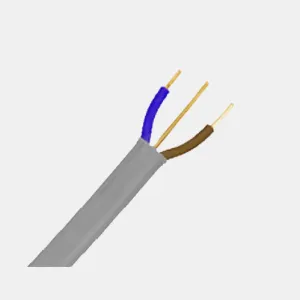
Cu/PVC/PVC 6242Y Núcores gêmeos planos e cabos terrestres
Sua classificação: Fio de construçãoVistas: 272Número:Tempo de liberação: 2025-02-19 02:45:27BS6004 Cabos gêmeos e terrestres de 624 anos se referem aos núcleos planos com a Terra com uma tensão de300/500V. Eles poderiam ser um cabo único +terra 6241y, núcleos gêmeos +cabo de terra 6242y, três núcleos +terra 6243y, normalmente usava instalação fixa e iluminação industrial.Esses cabos Twin & Earth seguem o padrão australiano AS/NZS 5000.2, referido como TPS, possuem diferentes estruturas de cabo e tensão (450/750V), faça o download do PDF para obter uma especificação de detalhes.O gráfico de especificação a seguir mostra os tamanhos de cabo gêmeos e terrestres disponíveis.Seção transve...
Notícias
Categoria:
Nenhum resultado de pesquisa!
Caso
Categoria:
Nenhum resultado de pesquisa!
Vídeo
Categoria:
Nenhum resultado de pesquisa!
Download
Categoria:
Nenhum resultado de pesquisa!
Recrutamento
Categoria:
Nenhum resultado de pesquisa!
Produtos recomendados
Nenhum resultado de pesquisa!



 Telefone
 Correspondência